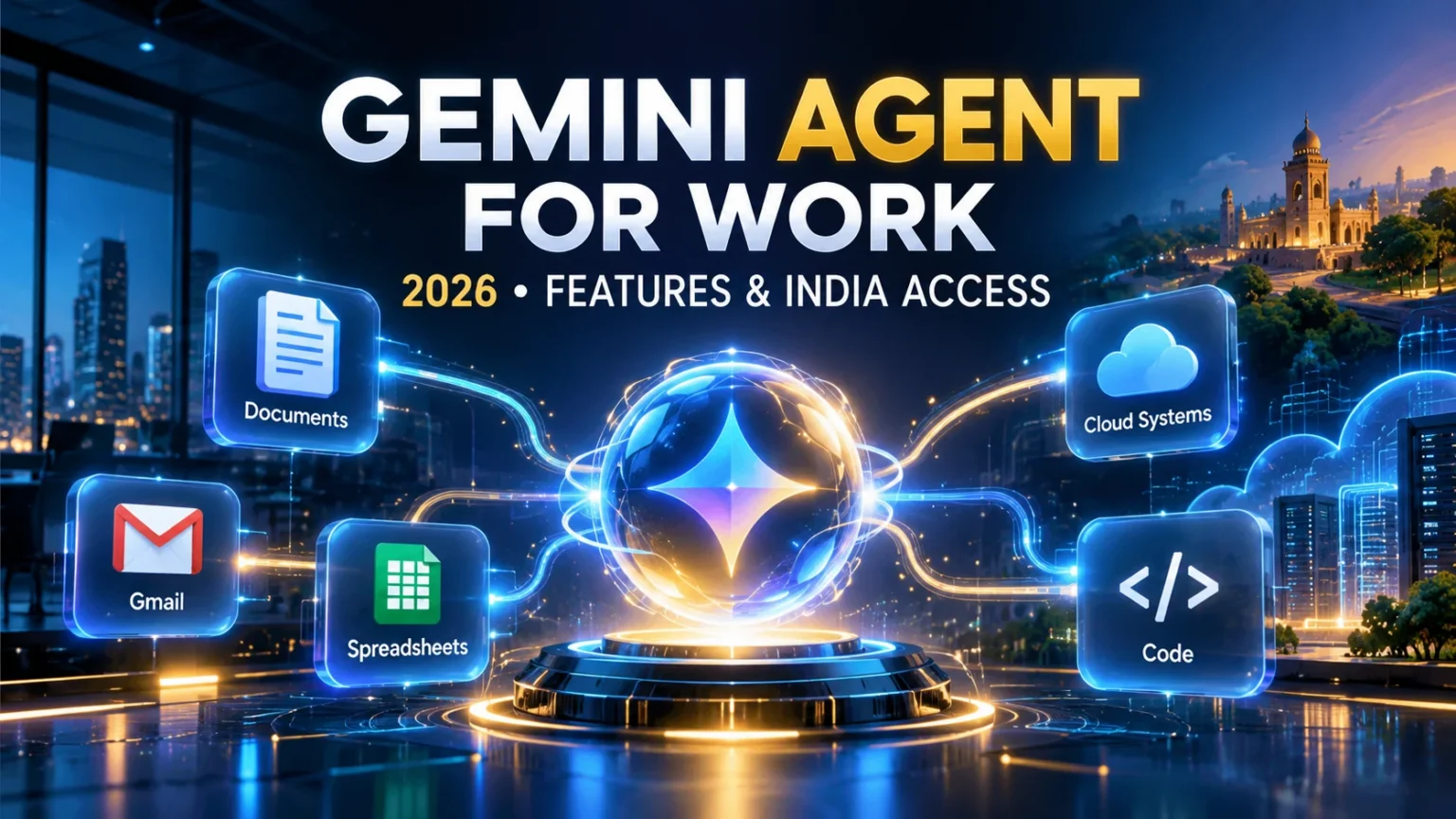
Updated 12 October 2026. Google Cloud unveiled the Gemini agent for work at its Gemini at Work event on 8 October 2026. The announcement is about an AI assistant that can plan and execute multi-step work across business tools — not just answer prompts in a chatbot. It combines knowledge work, connected applications, content creation and code workflows with enterprise controls.
But is Google's new Gemini agent available to everyone in India? No. Reporting on the launch describes the new universal agent as being in private preview for enterprise customers. That is different from the consumer Gemini app and from existing Gemini functionality in Google Workspace. This guide explains what Google announced, which capabilities have been described, who can access them and how Indian professionals and businesses should assess the news.
What is the new Gemini agent for work?
Google's concept is a single AI agent that works with a company's data and applications to deliver completed outcomes. Instead of asking a chatbot to draft one email and then manually switching tools to update a spreadsheet and create slides, an employee could delegate a broader task that spans these steps — provided the organization's permissions and integrations allow it.
In Google's official Gemini at Work 2026 announcement, the agent is described as able to answer questions, generate media, handle knowledge tasks, write or run code, and use connected enterprise tools. The emphasis is on completing an objective across multiple systems, rather than producing only a text response.
That does not mean any new Gemini account automatically receives access to these functions. Google is presenting an enterprise product vision with administrative governance and staged availability.
Gemini agent features announced in October 2026
1. One agent across work applications
Google describes access across its Workspace tools including Gmail, Drive, Docs, Sheets, Slides, Chat and Calendar, as well as third-party business systems. Examples of supported integration categories include Microsoft 365, Slack, Jira, Salesforce and databases. Exactly what an organization can use will depend on configuration, connectors and permissions.
2. Multi-step tasks and persistent execution
The agent is designed to carry out work that requires several steps or applications. Google says longer tasks can continue in the cloud rather than relying on an open browser tab. That could be useful for preparing reports, researching a topic and formatting the findings in a document.
3. Specialist agents working together
Google describes temporary sub-agents that can take on parts of a broader assignment. It also introduced the idea of persistent coworker agents with organizational identities, subject to company-controlled access. These are features of the enterprise agent system, not claims that every individual user can create a digital employee immediately.
4. Data analysis and developer workflows
Alongside the universal agent, Google announced analytics skills for answering business questions using connected data and developer-oriented tools for generating or testing data code. In an enterprise context, that can include BigQuery-connected reporting, PySpark workflows and dashboards.
5. Model choice and cost control
Google says the agent can route different tasks to different AI models, including its Gemini models and supported third-party models. The announcement also describes smart routing and enterprise spend caps. These are organizational cost-management capabilities; they do not establish a free unlimited tier for individuals.
Is the new Gemini agent available in India?
There is no basis to claim that the new universal Gemini agent is publicly available to every user in India as of 12 October 2026. Coverage of the October 8 launch identifies it as an enterprise private-preview offering. Google's public announcement explains capabilities but does not provide a general India-wide sign-up date or a standalone rupee subscription price.
Indian companies already using Google Cloud, Workspace or Gemini Enterprise should ask their Google account team about preview eligibility, rollout timing, applicable data residency requirements and administration settings. Small businesses should not buy a plan solely on the assumption that this particular new agent is automatically included.
| Product | Main purpose | Access takeaway |
|---|---|---|
| Consumer Gemini app | Everyday questions, writing and personal AI features | A separate consumer experience; plan features vary |
| Gemini in Workspace | AI help in Gmail, Docs, Sheets and other work apps | Depends on Workspace plan, admin settings and rollout |
| New Gemini agent for work | Enterprise-wide, multi-step delegated work | Private preview at launch; not a general public rollout |
Google's term “Gemini” appears across multiple products, so headlines about the new agent should not be confused with a new consumer app feature.
Five practical use cases for Indian professionals
The following are illustrative workflows based on announced capabilities, not confirmations that any particular Indian account can perform them today.
Sales reporting for a small business
A manager could ask for sales trends from approved records, with an explanatory report and slides for a team meeting. The main benefit would be connecting analysis and presentation steps, with each source and calculation still checked by a person.
Project updates for technology teams
An authorized agent could potentially gather the status of work items from project tools, summarize blockers and draft an update in a shared document. Project owners should still validate timelines and decisions.
Support and operations summaries
Teams could use connected help-desk data to identify recurring issues, group support requests and propose documentation updates, while using approvals for any action that changes customer accounts.
Marketing campaign preparation
Marketing teams could ask for a campaign brief, draft copy and a presentation using approved product documentation. Brand claims, advertising rules and factual accuracy still require review.
Data analytics learning and exploration
Analysts can study how natural-language questions map to queries, charts and structured reports. Students without enterprise access can still practice these concepts with spreadsheets and existing AI tools. Read our practical AI and Excel analytics guide to get started.
What about students and individual developers?
Students and individual developers should treat the October 8 news as a development in enterprise AI rather than a promise of free personal access. Useful preparation includes learning APIs, permission models, structured prompts, data validation, logging and human-in-the-loop approval patterns.
For example, a junior developer can build a small practice project that takes a CSV, summarizes the figures and produces a report. That demonstrates the underlying agent workflow without requiring access to a new enterprise preview.
If you are deciding which everyday AI tool to use for coursework, our ChatGPT vs Gemini vs Claude guide for students compares more immediately relevant learning uses.
Security and privacy: what businesses should verify
Google's launch emphasizes enterprise identity, scoped permissions, audit trails, sandboxing and policy enforcement. These are important precisely because an agent that can read a file, send a message or execute code may cause more harm than a chatbot that only drafts text.
- Least privilege: Connect only the systems and data needed for a task.
- Approval steps: Require human confirmation before external messages, purchases, deletions or irreversible changes.
- Auditability: Record which agent performed an action and what sources or tools it used.
- Data handling: Review your organization's legal, privacy and residency requirements before moving confidential data between services.
- Cost controls: Set limits and monitor long-running workflows or model usage.
Do not assume that an agent is safe merely because it is embedded inside familiar office software. Administrators should test access boundaries and failure recovery before enabling autonomous workflows.
How is this different from a normal AI chatbot?
| Traditional chatbot interaction | Enterprise agent workflow |
|---|---|
| Answers a question or drafts content | Can plan several steps toward an assigned outcome |
| Often requires manual copying between apps | May use authorized connectors and tools |
| User manages most follow-up actions | Can coordinate approved sub-tasks and report results |
| Usually short, conversation-based sessions | Designed to support longer, persistent workflows |
This comparison describes the product direction and should not be read as a benchmark of real-world accuracy, speed or availability.
Frequently asked questions
Was the Gemini agent announced on 8 October 2026?
Yes. Google Cloud introduced the universal agent for work during Gemini at Work on 8 October 2026.
Can I use it for free with Gmail in India?
Google has not announced general public access to the new enterprise agent through a free Gmail account. The product is distinct from consumer Gemini features.
Does the Gemini agent work with Microsoft 365 or Slack?
Google describes integration with third-party applications and channels including Microsoft 365 and Slack. Availability depends on enterprise configuration, connectors and authorization.
Can it write and run code?
Google lists code generation and execution among the announced capabilities. Organizations still need appropriate controls for access, sandboxing and approvals.
Is there an official India launch date or price?
As of this article's update, no general-availability date or standalone Indian price for the new universal agent has been confirmed in the cited announcement.
Bottom line
Google's Gemini agent announcement signals a move from stand-alone AI answers toward delegated, connected business workflows. For Indian companies, the immediate questions are preview eligibility, integration readiness, governance and costs. For students and everyday users, the useful takeaway is to learn the skills behind trustworthy agents while avoiding headlines that suggest the new enterprise product is already free for everyone.
Official sources and editorial note
- Google Cloud — Gemini at Work 2026: Introducing the Gemini agent (8 October 2026).
- Google Blog — Introducing the Gemini agent (8 October 2026).
- Google Cloud — Empowering SMBs to do more with Gemini (8 October 2026).
Editorial note: This independently written explainer was prepared with AI assistance based on the official October 8 announcements and launch reporting. Feature descriptions do not imply hands-on testing or universal access in India. Product availability can change after publication.