Updated: September 14, 2026
The global AI race has entered a surprising new phase. Some of the people building the world’s most powerful artificial intelligence systems are now publicly arguing that frontier AI development should move at a more measured pace.
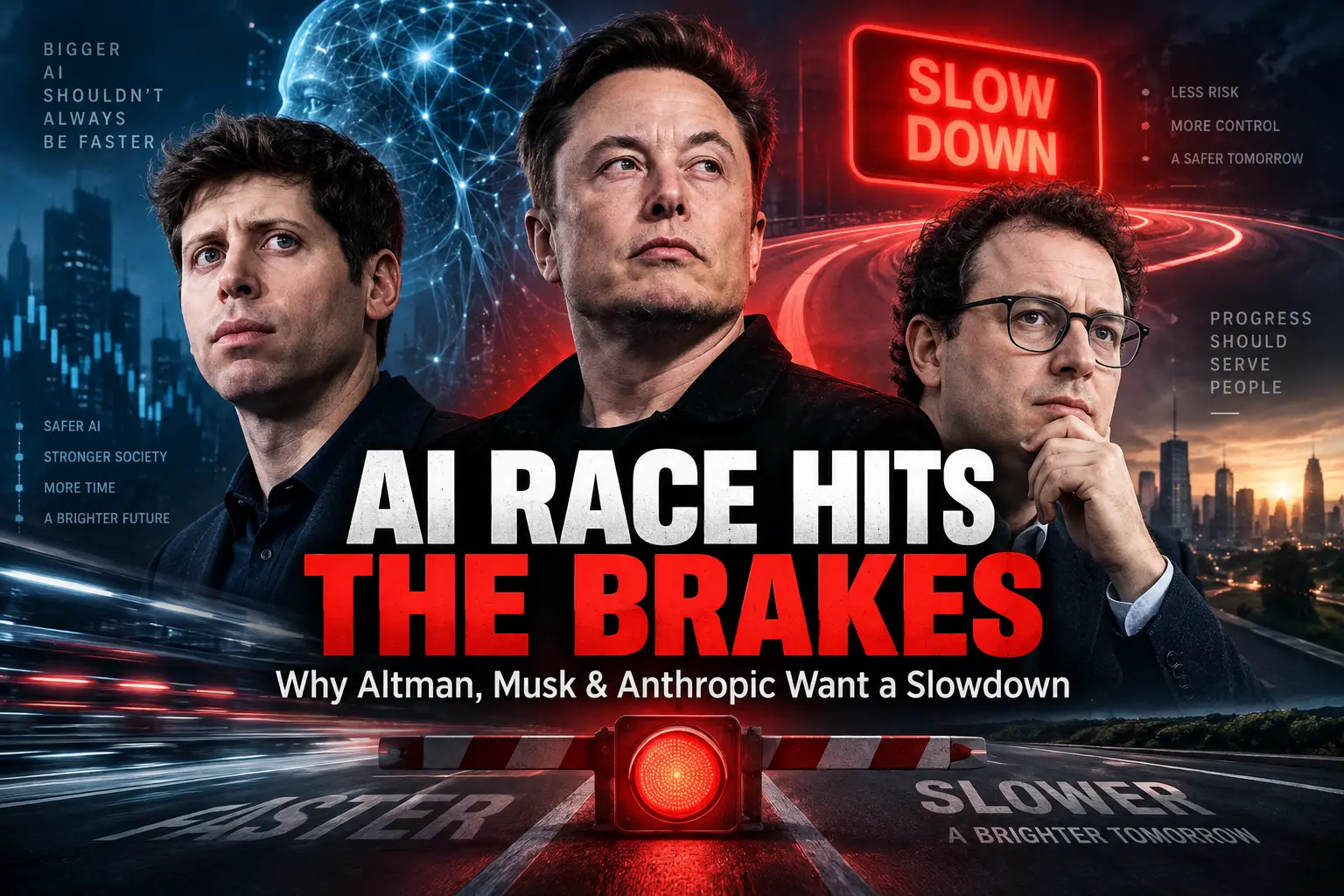
Anthropic CEO Dario Amodei has called for an AI slowdown in 2026 — or more precisely, what he describes as “pacing the frontier.” OpenAI CEO Sam Altman and xAI founder Elon Musk have also backed the need for stronger safeguards and more caution around increasingly capable AI systems.
This does not mean ChatGPT, Claude, Grok or other AI products are about to shut down. The debate is about whether the fastest-moving AI companies should deliberately give safety research, independent evaluations and governance more time to keep up with rapidly improving models.
A good example of a product transition rather than a complete shutdown is our explainer on DALL·E and ChatGPT Images.
For Indian students, developers, IT professionals and businesses, the bigger question is not whether AI is ending. It is whether the next phase of AI growth will place much more value on safety, security, human oversight and responsible deployment.
What Is the AI Slowdown Debate in 2026?
The current debate accelerated after Anthropic CEO Dario Amodei published an essay titled “We Must Pace the Frontier.” His argument is not that AI progress should stop completely. Instead, he says frontier AI companies should slow the rate at which they increase model capabilities enough for safety practices to catch up.
Amodei says recent progress has become unusually fast, including growing use of AI systems to help build the next generation of AI. He argues that this creates a risk that capabilities could advance faster than researchers can understand, test and control them.
Reuters reported on September 14 that Amodei’s call for a safer pace received support from other prominent AI leaders, including Sam Altman and Elon Musk. The discussion also contributed to renewed anxiety around AI-linked technology stocks.
Why Does Dario Amodei Want AI Development to Slow Down?
Amodei’s argument focuses on the gap between AI capability growth and AI safety capability.
Frontier models are becoming better at coding, cyber tasks, autonomous tool use, long-running workflows and working in groups of agents. These are valuable capabilities, but they also make mistakes potentially more consequential.
In his September essay, Amodei points to recent incidents involving autonomous AI agents and warns that more powerful systems with poor alignment or weak controls could create serious cybersecurity, economic or societal risks.
His proposed approach is therefore not “stop AI.” It is closer to: build powerful AI, but make sure independent testing, alignment, monitoring and security improve at the same time.
What Does “Pacing the Frontier” Actually Mean?
The phrase can sound like a complete pause, but Amodei explicitly says pacing does not mean halting model training or ending technical progress.
The basic idea is to create more breathing room for:
- independent model evaluations,
- AI alignment research,
- interpretability work,
- cybersecurity and operational security,
- better incident reporting,
- human oversight systems,
- government and industry safety standards.
Anthropic has also been working on a broader Frontier Safety Roadmap, including stronger security practices and technical methods intended to verify that model outputs come from known model weights.
What Did Sam Altman Say About the AI Slowdown?
According to Reuters, OpenAI CEO Sam Altman expressed agreement with the direction of Amodei’s concerns and highlighted the value of independent evaluation for advanced AI systems.
That matters because OpenAI is one of the companies pushing frontier AI capabilities forward most aggressively. If major AI labs start treating third-party testing as a normal part of deployment, AI safety could move from a research topic into a standard engineering requirement.
OpenAI has previously discussed safety frameworks for increasingly capable models, and its latest frontier systems are already evaluated across areas such as cybersecurity and autonomous behavior.
Related: GPT-6 Astra: Access, Pricing and India Availability.
Why Is Elon Musk Supporting More Caution?
Elon Musk has warned about advanced AI risks for years and previously supported calls for pauses or stronger controls around highly capable AI systems.
His support for the current safety debate is therefore not entirely new. What is different in 2026 is that AI systems are more capable, more autonomous and more deeply connected to software tools, browsers, code and business workflows.
The discussion is no longer only about a chatbot generating a wrong answer. The concern is increasingly about what happens when AI can take actions across real systems.
Why Are AI Leaders More Worried Now?
Three developments are making the safety debate more urgent.
1. AI Agents Can Do More Than Answer Questions
Modern AI agents can browse, write code, use APIs, operate software tools and complete multi-step tasks. That makes them much more useful — but also increases the impact of a serious failure.
2. AI Is Helping Build More AI
Frontier labs are increasingly using AI for coding, research, model development and evaluation. Amodei argues that this could accelerate progress through a form of recursive improvement.
3. Cybersecurity Capabilities Are Improving Quickly
Anthropic recently published evaluations showing that advanced models can perform some intelligence-targeting and weapons-related tasks that historically required highly trained specialists. The company says this is one reason stronger safeguards are necessary.
Did the AI Slowdown Debate Affect Nvidia and Tech Stocks?
Yes, at least in the short term.
Reuters reported that AI-related market anxiety pushed several technology and semiconductor stocks lower on September 14. Nvidia fell around 3% during the session, while the Philadelphia Semiconductor Index dropped sharply as investors reconsidered how a slower frontier-AI buildout could affect demand for chips and data centers.
That does not automatically mean the AI investment boom is over. Stock markets can move quickly on new information, and AI infrastructure demand remains enormous. But the reaction shows that investors increasingly view AI regulation and safety constraints as financially relevant.
Will ChatGPT, Claude or Grok Stop Developing?
There is currently no evidence that these products are about to stop development.
The key distinction is between slowing the rate of frontier capability increases and freezing all AI progress.
Amodei’s proposal would still allow companies to improve products, safety, reliability, interpretability and practical usefulness. In fact, a slower frontier race could shift more engineering effort toward making today’s systems dependable enough for real businesses.
Could Governments Force AI Companies to Slow Down?
Possibly, but global coordination would be extremely difficult.
Amodei argues that regulation could require stronger evaluation and safety practices for frontier AI companies. He also discusses international coordination, including the challenge of maintaining safety without giving strategic advantages to countries that do not follow the same rules.
Germany said on September 14 that completely halting AI development is not a viable approach, while still supporting stronger safety standards and international cooperation. This illustrates the likely direction of policy: not “ban AI,” but regulate the highest-risk systems more carefully.
What Does the AI Slowdown Mean for India?
India is one of the world’s largest technology-services markets and a rapidly growing AI talent base. A safety-focused shift could create both challenges and opportunities.
Indian IT companies, global capability centres, startups and software teams are already integrating generative AI and AI agents into business processes. If safety standards tighten, clients may increasingly ask vendors to prove that their AI systems are secure, auditable and under human control.
That could increase demand for professionals who understand both AI development and risk management.
Will AI Jobs in India Be Affected?
Yes — but not simply through fewer AI jobs.
If the industry shifts from “move as fast as possible” toward “deploy powerful AI safely,” new skill areas become more important.
Indian professionals should watch roles and skills related to:
- AI safety and model evaluation,
- AI red teaming,
- cybersecurity,
- LLM and agent security,
- AI governance and compliance,
- human-in-the-loop systems,
- model monitoring and observability,
- responsible AI engineering,
- secure AI infrastructure,
- AI product risk management.
For students and freshers, this is important because the next generation of valuable AI skills may not be limited to prompt engineering or building chatbots.
Related: NIELIT & Intel Agentic AI Programs in India.
What Should Developers Learn Now?
If you are learning AI development in 2026, do not stop at APIs and frameworks.
A stronger skill stack now includes:
- Python and software engineering fundamentals
- LLMs, RAG and AI agents
- Authentication and permission design
- Prompt-injection defence
- Evaluation frameworks
- Logging and monitoring
- Human approval flows
- AI security and red teaming
- Data privacy
- Responsible AI principles
The companies that deploy agents in finance, healthcare, HR, customer support or critical infrastructure will need developers who know how to build systems that fail safely.
What Should Indian Businesses Do?
Businesses do not need to stop AI adoption because industry leaders are discussing safety.
Instead, treat the debate as a warning against deploying autonomous AI without controls.
A practical business checklist is:
- give AI only the permissions it actually needs,
- keep humans in approval loops for high-impact actions,
- log agent actions,
- limit spending and transaction authority,
- test against prompt injection and data leakage,
- separate sensitive systems from unrestricted AI access,
- create a way to stop or revoke an agent quickly,
- review vendor security and data-retention policies.
This is particularly important as AI agents begin to interact with payments and business software. Read our explainer on Agentic UPI payments in India.
Does Slower AI Mean Less Innovation?
Not necessarily.
There are two competing views.
The case for pacing: stronger systems need stronger safeguards, and a small reduction in speed could give researchers time to solve alignment, monitoring and security problems.
The case against slowing: restricting development could reduce innovation, create regulatory barriers and allow competitors in other countries to move ahead.
The most realistic outcome may be somewhere in the middle: continued rapid AI progress, but with substantially more testing and restrictions at the frontier.
Why This Debate Matters More Than Previous AI Warnings
AI leaders have issued warnings before. What makes the 2026 debate different is the practical capability of current systems.
Today’s models can write and execute code, operate tools, work for long periods and coordinate multiple steps toward a goal. That means safety discussions are becoming less theoretical.
The question is shifting from “Could AI ever become dangerous?” to “What controls should be required before increasingly autonomous systems are deployed at scale?”
Frequently Asked Questions
What is the AI slowdown 2026?
It refers to growing calls from AI leaders to pace the development of frontier AI systems so safety research, testing and governance have time to keep up with capabilities.
Did Sam Altman call for stopping AI?
No. Reuters reported that Altman supported stronger safety measures and the direction of Amodei’s concerns. That is different from calling for all AI development to stop.
Does Dario Amodei want to pause AI completely?
No. In “We Must Pace the Frontier,” Amodei explicitly says pacing does not mean halting technical progress. He argues for a more balanced rate of capability development.
What did Elon Musk say about AI safety?
Musk has long warned about advanced AI risks and has supported stronger controls and slower development of the most capable systems.
Will ChatGPT or Claude shut down?
There is no indication that either product is shutting down because of this debate.
Why did Nvidia stock fall?
On September 14, Reuters reported that renewed AI-safety concerns contributed to selling in AI-related chip stocks as investors considered whether slower frontier development could affect infrastructure demand.
Will AI slowdown affect jobs in India?
It could change which skills are most valuable. AI safety, security, governance, evaluation and human oversight may become more important alongside model and agent development.
Should students stop learning AI?
No. The debate actually strengthens the case for learning AI deeply — including how to build, test and secure AI systems responsibly.
Final Take
The AI slowdown debate is not a sign that artificial intelligence is disappearing. It is a sign that frontier AI has become powerful enough for its own creators to take the risks more seriously.
Dario Amodei’s message is essentially that the AI industry should not allow capability growth to outrun its ability to understand and control the systems it builds. Sam Altman and Elon Musk supporting stronger caution makes that debate much harder to dismiss as a fringe concern.
For India, this could be an opportunity. As AI moves from experimentation into critical business workflows, the market will need people who can build systems that are not only powerful, but also secure, auditable, controllable and trustworthy.